The El Niño Phenomenon and the brake on mining and oil activities will hit the Ecuadorian economy in 2024, which will barely grow 0.8%, according to the ECB.
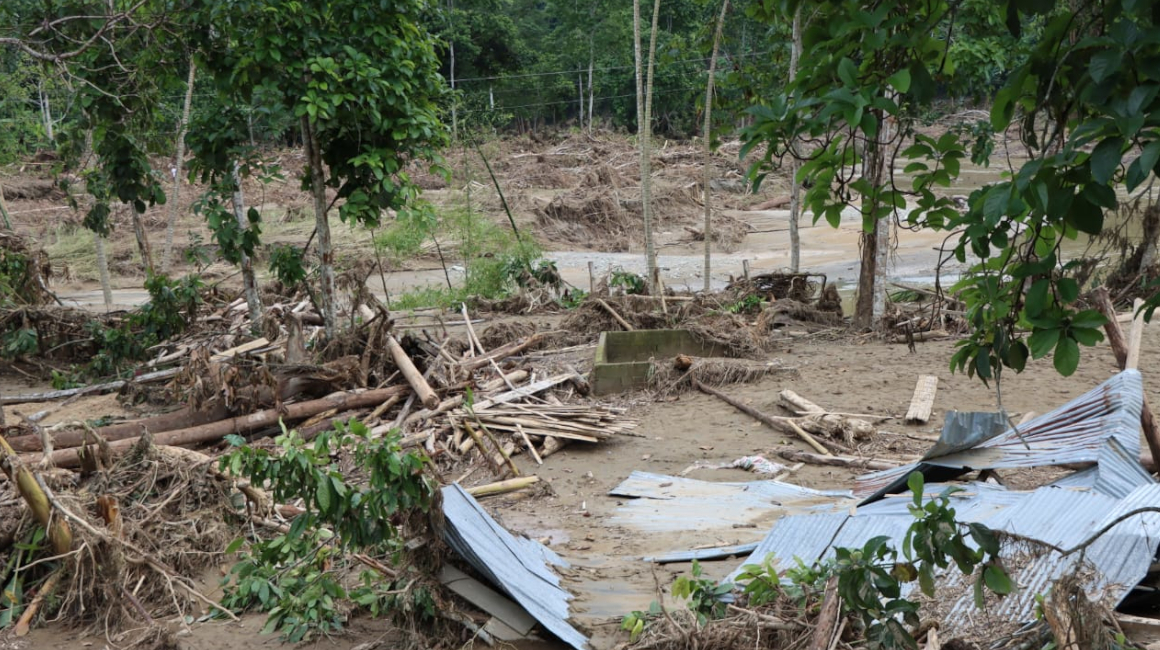
Havoc caused by winter in Esmeraldas, in June 2023.
Stagnation, that is the scenario for the Ecuadorian economy in 2024, according to the latest projections published by the Central Bank of Ecuador (BCE).
The ECB projects growth for Ecuador’s economy for the following year of 0.8%.
These are not surprising figures, since the economy has been slowing down, says José Hidalgo, director of the Corporation for Economic Development (Cordes).
In fact, the ECB predicts that the Ecuadorian economy will grow just 1.5% in 2023, when at the beginning of the year it had projected an expansion of 2.6%.
El Niño phenomenon
There are several factors that explain the projection for Ecuador’s Gross Domestic Product (GDP) in 2024, but the main one is the poor performance of Ecuadorian exports, which would fall by 7%.
Among the sectors with the worst results in 2024 will be the shrimp sector, with a drop of 6.4%; and fishing, with a decrease of 8.6%.
The above is due to the possible effects of the El Niño Phenomenon, which is about to reach the coasts of Ecuador.
A poor performance of the economy will also lead to a contraction in imports, which will fall by 3.3%, as projected by the Central Bank.
ITT will have to close.
Another sector with negative performance is oil. The Central Bank projects that this activity will fall 8.2% next year due to the closure of the Ishpingo-Tambococha-Tiputini (ITT) block.
This after, in the popular consultation on August 20, 2023, the majority of Ecuadorians voted in favor of keeping the oil from this area on land. Petroecuador, the country’s largest state oil company, has one year to dismantle the block’s infrastructure.
The Government has warned that the State will no longer receive USD 1.2 billion a year from oil revenues.
Guillermo Lasso has hinted that he will not fulfill the mandate of the popular consultation in the ITT during his administration, which will conclude no later than January 2023. It will, therefore, be the next government that will have to close the oil wells.
The above, in addition, is a factor of uncertainty for private investment, since the decision retroactively affects a project in progress, says Alberto Acosta Burneo, editor of the economic publication Economía Semanal.
In fact, the ECB projects that investment in the country, both public and private, will decline 0.1% next year.
Mining retreats
The investment scenario is also complicated by judicial decisions, says Alberto Acosta Burneo.
Acosta Burneo refers to the protection action filed by the Confederation of Indigenous Nationalities of Ecuador (Conaie) before the Constitutional Court (CC).
The request led the CC to temporarily suspend the environmental consultation processes of 176 public and private projects, valued at USD 2,000 million.
Although the concern of the indigenous movement points to the mining sector, the request for protective action ultimately paralyzed investments in sectors; among them, the hotel sector, the tourist sector and even the health sector.
Other works that cannot begin are also municipal sanitation projects.
The above explains why the Central Bank projects a decrease of 2.6% for the mining sector, after four years of consecutive growth. In 2023 alone, the mining sector could close with a growth of 7.6%.
Political uncertainty will also affect the poor performance of the economy in 2024. Between December and January, a transitional government will take office, which will slow the injection of private capital.
And household consumption?
Despite the pessimistic scenario, household consumption will continue with positive indicators.
The Central Bank expects household spending to grow 2.3%, although slightly below the 2.6% forecast for 2023.