The strengthening of relations between the United States and Ecuador, achieved at the IV meeting of the Trade and Investment Council with the United States (TIC) , is applauded by the business sector.
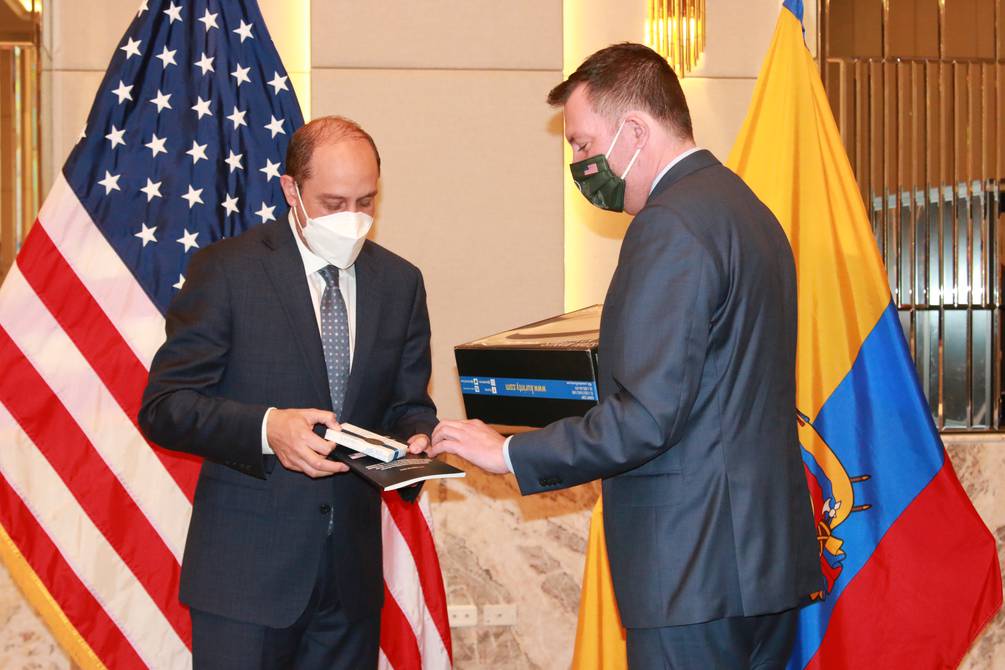
The Minister of Production, Julio José Prado (left), and the Ambassador Jayme White, Deputy Commercial Representative, led the IV meeting of the TIC. Photo Courtesy Ministry of Foreign Trade.
At this meeting, held in Guayaquil between February 15 and 16, representatives of the delegation from the Office of the United States Trade Representative (USTR) and officials from the Ministry of Production addressed agricultural issues, labor, environmental and also cooperation issues. On this last point, the US embassy in Ecuador pointed out that both countries consolidate bilateral commercial cooperation in six areas: intellectual property; farming; market access; customs and trade facilitation: labor, environment; and investment, services and digital commerce.
During the meeting, the progress of the Protocol to the Trade and Investment Council Agreement or First Phase Agreement, which has been in force since August 2021, was also analyzed, and the possibility of moving towards a Second Phase Protocol was defined.
For this last issue, the Vice Minister of Foreign Trade, Daniel Legarda, indicated that a delegation will travel to Washington in mid-2022 to have more clarity on the issues that will be deepened in this eventual protocol.
Iván Ortiz, director of the Business Center of the Ecuadorian-American Chamber of Commerce (Amcham) , said that the results of the meeting show that the bilateral agenda is no longer focused only on the dynamics of product marketing, but on issues such as environment and labor: “These are aspects of the new generation of trade agreements that are in line with the needs of caring for nature and labor rights.”
In fact, he pointed out that the technical meetings allow establishing cooperation needs. For example, to continue in a more agile way with the implementation of the provisions contemplated in the Phase 1 protocol, which is currently underway.
This agreement aims to facilitate trade, investment and good regulatory practices; guarantee efficient and transparent customs procedures that reduce costs and guarantee predictability for importers and exporters; in addition to promoting cooperation in the field of trade facilitation and customs enforcement.
For Ortiz, the dynamic will be to move forward and generate mechanisms in additional areas with the US Executive that allow us to walk towards that global agreement that is expected to be reached. Likewise, with the Congress of that country, press for the discussion of the bipartisan project of the United States-Ecuador Association Law and that this may lead to the proposal of new projects that give greater weight to what is being done with the Executive.
The Amcham spokesperson noted that the proposals in the fourth and fifth sections of the presented bill add to the achievement of the objective of reaching an agreement in the future.
Felipe Ribadeneira, president of Fedexpor, said that, in general terms, this type of rapprochement through ICT is positive, because it reinforces the bilateral relationship and the intention of eventually signing a far-reaching instrument. Also, because there is total involvement of different sectors of civil society and unions. “Not because there is no start of negotiations means that the talks are negative,” stressed the leader.
For his part, Miguel Ángel González, president of the Ecuadorian Business Committee (CEE), said that at this time it is key that the public and private sectors are united. “We know that internal issues are being resolved in the United States and it is the government’s priority, but there is openness and progress can be made in what is required to reach a treaty.”
Likewise, Alejandro Martínez, president of the National Association of Producers and Exporters of Flowers of Ecuador (Expoflores), applauded the intention to strengthen the bilateral relationship with the North American country, since, he considers, the road to commercial integration is “paved”. .
In addition, he points out that this traces a path for treaties with other countries and real opportunities for companies of all sizes in the country. “We are fixing the mistakes that we have made for 18 years, running over (back then) not only the trade agreement, but also a natural axis of trade.”
In this regard, he said that in recent years Ecuador has implemented measures such as safeguards, non-tariff measures, technical standards and import licenses that have interrupted investment opportunities. “You generate so many limitations that the investment that grows is the one that has the most capital or has opportunity niches, compared to other countries,” said Martínez.
Julio José Prado, Minister of Production, pointed out that the intention to reach a long-term agreement has been made clear: “We have emphasized the historic relationship between the two countries and that their balances are complementary. For this reason, we need a commercial agreement with our main partner”.
Until the end of 2021, Ecuador exported to the United States $3,641 million in products such as shrimp, bananas, cocoa, fresh fish and flowers, according to the Ecuadorian Federation of Exporters (Fedexpor). (I)