The possibility of Ecuador achieving a Free Trade Agreement with its main trading partner is increasingly receding, which is why the Government resorts to an alternative plan.
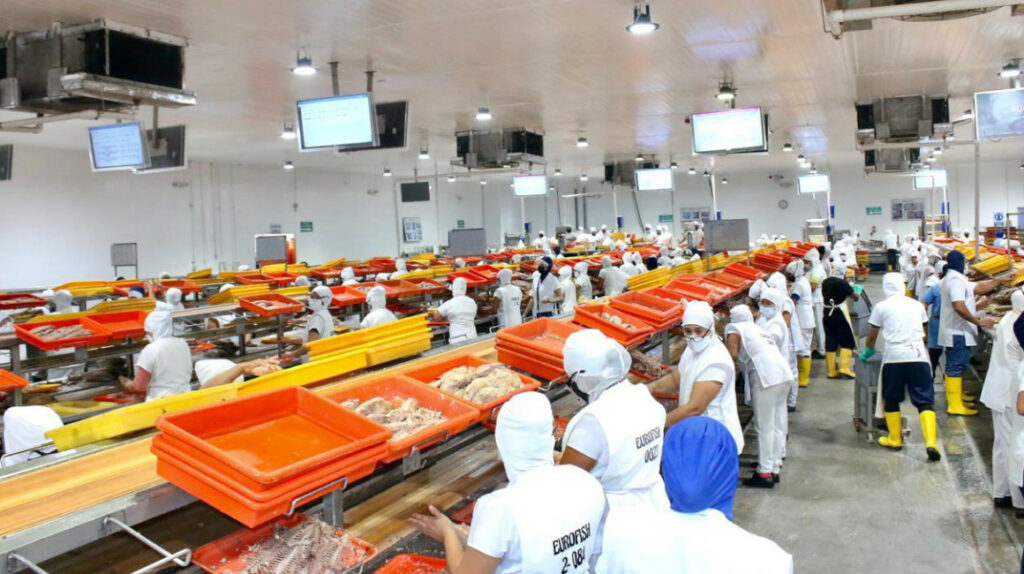
Eurofish production plant, exporter of canned tuna and tuna loins. June 2021.
A possible inclusion of Ecuador in the system of tariff preferences offered by the United States to the Caribbean countries is the Government’s plan B to gain greater access for its exportable supply to that country.
This possibility was opened with a bill introduced by United States Senators Bob Menéndez and Jim Rish, in March 2023.
The objective of the legal initiative is that Ecuador can be a beneficiary of the Law of Economic Recovery of the Caribbean Basin, in force since 1983.
Representatives of the Government and the private sector will travel to Washington in June to outline a road map that will allow access to this law, the Minister of Foreign Trade, Investment and Fisheries, Julio José Prado, told PRIMICIAS.
Prado estimates that this way could give access to between 50% and 70% of the exportable supply from Ecuador to the United States, with a 0% tariff.
The beneficiaries
Among the products benefited, says Prado, would be broccoli, bananas, shrimp, and tropical fruits. In addition to tuna and textiles.
The vice president of the Ecuadorian Federation of Exporters (Fedexpor), Xavier Rosero, says that every year that Ecuador continues to pay tariffs to enter its products into the United States, it loses USD 200 million in growth in exports to that market.
How much are the tariffs?
Shrimp and bananas, the main non-oil export products pay 0% tariffs in the United States because they are one of the import products that have preferences from any country.
Others, on the other hand, are protected by the Generalized System of Preferences (SGP), which also offers tariff reductions. But this system has been stopped since 2020.
Some products that are part of this scheme are flowers, mango, cables. In addition, certain items of wood and manufacture, canned fruits and vegetables, and fresh vegetables. Tariffs on these products range from 1% to 17.9%.
Those who pay the most fees
The products that pay the most import taxes upon arrival in the United States and that are not included in any system of preferences are: broccoli, with 15%, and canned tuna, between 12% and 35%.
What must Ecuador comply with?
The director of the Business Center of the Ecuadorian American Chamber of Commerce (Amcham), Iván Ortiz, explains that among the requirements that the Caribbean Basin Economic Recovery Law requires of beneficiary countries are:
- Not being a country with a communist regime.
- Respect intellectual property rights.
- Do not nationalize or expropriate US companies.
- Comply with international regulations.
Unlike the Andean Tariff Preferences and Drug Eradication Law (Atpdea), this rule does not require cooperation from the beneficiary country in the fight against drugs.
Benefit for SMEs
The approval of this bill by the United States Senate would bring oxygen to companies that export to that country, giving them the possibility of increasing their shipments, says Ortiz.
“More than 90% of the companies that export to the United States are small and medium-sized. Any increase in their sales has an impact on employment and these companies are the largest generators of jobs,” added Ortiz.
Ortiz explains that advancing the trade agenda with the United States is not only important to generate more employment, but also to prevent illegal immigration to the United States and avoid linking young people to criminal gangs.