Previous Story
Guayaquil is used as a border drug collection center
Posted On 02 Jul 2018
Ecuadornews:
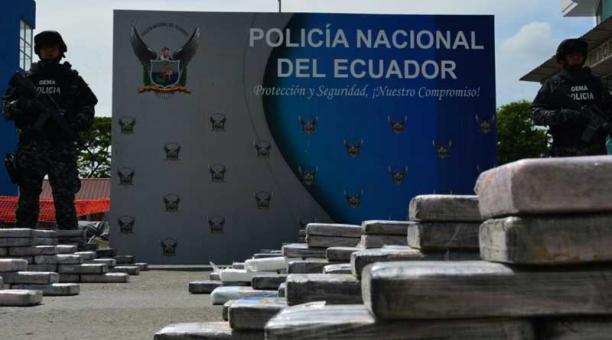
Guayaquil is increasingly important among the drug trafficking routes. The military controls on the northern border, in Esmeraldas, have influenced the drug traffickers to prefer this city and its seaport as the main collection center and the shipment of drugs to the international market.
Agents of Narcotics of the Police have identified that to the Main Port arrives the alkaloid that leaves Esmeraldas, Sucumbíos and Carchi, border provinces with Colombia. One of the investigators told this newspaper that the groups, on the Colombian side, charge local gangs associated with drug trafficking with the transfer of illegal merchandise from the border.
The idea is that Ecuadorians mobilize the alkaloid inside the country and take it to Guayaquil without going through Esmeraldas or Manabí. The journey is not direct, but surrounding even Quito. Shipments are made progressively: the border is crossed and are collected in Napo, Orellana, Santo Domingo and Chimborazo.
There they leave one or two days until the drug moves to Buenos Aires city. For this work they use cranes, low range vehicles, trucks and even interprovincial transport buses in which double funds are made. “The bands know the routes and use roads with little control. After having accumulated the alkaloid in non-border provinces, they are sending little by little to the wineries and workshops in Guayaquil. When they already have the complete merchandise they undertake shipments abroad, “said one agent.
One of the last cases was registered on June 22, 2018. Investigations by the Ports and Airports Information Unit (UIPA) led to the seizure of 218 kilos of cocaine hydrochloride, which were to be collected at a home in the south of the country.
This capture was made when a truck carried seven bags with brick-like packages; Two citizens were mobilized in a car and carried out guiding and security tasks for that transfer. The origin would have been the canton El Triunfo, but before it came from the Amazon and its manufacture was Colombian.
A few days before, on June 16, another operation was carried out. This time the police seized 432 kilos of cocaine that were hidden in a recycler located in Cooperativa Los Helechos, in the Duran county, where two foreigners were also detained, who remained in the country as refugees.
The modus operandi of this band would be to move the drug from the border to Duran and Guayaquil in vehicles with hidden compartments. In the two cantons of Guayas, the mafias had places where they stored the drug and then put it in containers and send them to the United States and Europe.
Carlos Alulema, national director of antinarcotics, said that the passage of drugs in Esmeraldas has decreased after military controls. However, Alulema said that this action has not served to diminish illicit activities in other coastal provinces such as Guayas, Santa Elena, Manabí and El Oro. “They are the same amounts in relation to last year.” Johnny Guzmán, prosecutor of the Transnational Organized Crime Unit, said that the main attraction of Guayaquil is the ease of storage of substances in canchons, warehouses and closed urbanizations in which there is no police presence.
Illegal groups are attracted to the “blind hook” modality, which allows drug contamination of containers that go to Central America and Europe. Between January 1 and June 28, the jurisdiction comprising Guayaquil recorded 373 drug seizures.
While on a national scale there were 1 906 interventions. Once the drug is stored in Guayaquil, drug traffickers send it in cargo ships to Europe and through the unpopulated beaches of Manabí to Central America. Only between June 14 and 19, three catches were registered in the Port of Guayaquil.
One of these cases was identified by the dogs of the Regional Canine Training Center (CRAC), which sniffed a shipment of shrimp. Inside 1 288 brick-like packages, covered with a brown adhesive tape, was found a whitish substance that tested positive for cocaine. Antinarcotics indicated that in 90% of the merchandise there was drug, and that nine boxes had other types of products such as soap and calcium chloride, which emanate odors.
This was the strategy they used to confuse the dogs and not be discovered. “The seized drug was one tonne and 442 kilograms, which would have an approximate value of USD 77.2 million in the European market, which makes it the largest percentage of the drug that has been seized so far,” said one of the Anti-narcotics agents.
Alulema said that in Guayaquil, 5 tons of narcotics were discovered in collection centers. Nationwide, the figure reached 36 tons last June, of which 29 were for the international market. Other figures reveal that 40% of the narcotics is sent to Central America, which is a transit route to the United States and 35% is transferred to Europe.
In context
The Government presented its Defense, Security and Development strategy in the border area in Esmeraldas. This, after the violence unleashed since January. Among the objectives of the new policy is to exercise ordering in terrestrial, aquatic and aerial spaces. (I)
Source: http://www.elcomercio.com/actualidad/guayaquil-acopio-droga-frontera-policia.html