British, American and Ecuadorian scientists discovered a huge, ancient and pristine coral reef in the depths of the Galapagos.
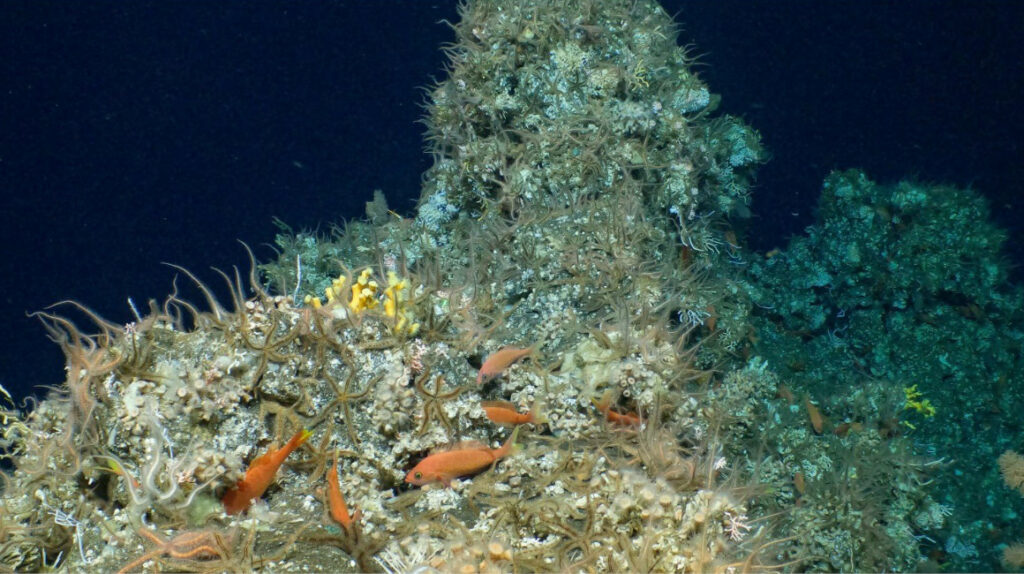
Panoramic of a part of the newly discovered coral reef in Galapagos, on April 17, 2023.
The “Galápagos Deep 2023” expedition already has its first great discovery: an immense and ancient coral reef, located in the depths of the Galapagos marine reserve.
The reef, located at a depth of between 400 and 600 meters, is on top of an uncharted seamount.
It extends for several kilometers between the islands of Santa Fe and San Cristóbal, in the central part of the platform of the Galapagos archipelago.
“The corals it’s built from probably have thousands of years of growth,” said oceanographer Stuart Banks, senior marine researcher at the Charles Darwin Foundation (CDF).
This organization is part of the international group of scientists aboard the US research vessel R/V Atlantis.
The expedition, which began on March 27 and ends on April 22, is funded by the National Science Foundation (NSF).
Piece of coral
So far, the scientific expedition has made about 16 dives of between 6 and 8 hours each, thanks to the “Alvin” submarine.
In one of them, they found the reef, which they refer to as the “chub of coral”, due to its similarity to a crescent.
After the El Niño phenomenon of 1981-1982, and that of 1997-1998, “more than 97% of the structural coral reefs were lost in the Galapagos.”
Now, the most extensive ones are in the islands of Wolf, Darwin and in some other patches.
The “chub” is the “first record of a deep-sea coral reef (…) that has survived in a pristine state for thousands and thousands of years,” said oceanographer Banks.
Although the scientists managed to cover just over a kilometer of the reef, they believe that it is “much more extensive” and that it is home to a high level of living biodiversity.
The finding is also important because fossil corals are “a window to the past” and will serve to study sea conditions “hundreds of thousands of years ago.”